


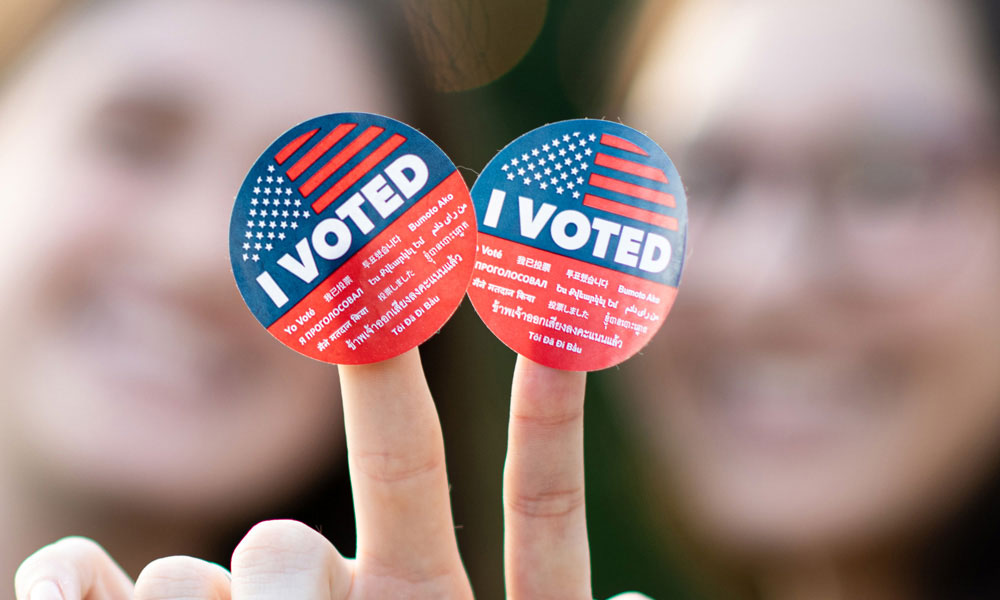

HUNTSVILLE | Early voting ahead of Scott County’s Aug. 6 general election dropped to a level not seen in almost 30 years.
With the close of polls Saturday, the final day of the two-week early voting period, a total of 3,694 voters in Scott County had cast their ballots ahead of the Aug. 6 general election and state primary. The last time that few people voted in the early voting period on the four-year cycle was 1998 — an election that saw Dwight Murphy elected to a second tenure as Scott County Executive and Don Sundquist win the Republican nomination for re-election as Tennessee Governor.
The numbers do not include Scott County’s “off-year” elections, which see only one county-wide race and a limited number of school board races and constable races on the ballot.

In 2022, the last election on the major four-year cycle, a total of 4,326 votes were cast during the early voting period, either in person or by mail. That was down somewhat from 2018, when a total of 4,810 votes were cast during the early voting period, a record that still stands in Scott County on the four-year cycle (early voting ahead of presidential elections has been higher).
Early voting in Tennessee began in 1994. That year 2,141 persons voted early in Scott County. The number climbed to 2,957 in 1998 and topped 4,000 in 2002. It had been above 4,000 every year on the four-year cycle since then, until this year.
Total in-person turnout (without absentee votes) during the early voting period on the four-year cycle looks like this:
- 1994: 1,920
- 1998: 2,657
- 2002: 3,858
- 2006: 4,336
- 2010: 4,035
- 2014: 3,989
- 2018: 4,457
- 2022: 3,955
- 2026: 3,501
The disparity is greater when considering the increase in registered voters. This year, a record 13,859 Scott Countians are registered to vote, according to Administrator of Elections Gabe Krahn. That means 26.7% of Scott County’s registered voters cast ballots during the 15-day early voting period, either in-person or by absentee ballot.
The percentage of registered voters — again, not including absentee voters — who have taken advantage of the early voting process on this election cycle through the years looks like this:
- 1994: 16.3%
- 1998: 21.5%
- 2002: 30.9%
- 2006: 31.2%
- 2010: 27.1%
- 2014: 29.4%
- 2018: 32.6%
- 2022: 29.8%
- 2026: 25.3%
Traditionally, more voters cast ballots during the early voting period than on Election Day. That has been the case in every election in Scott County since 2002, when nearly 52% of those who voted did so during the 15-day early voting period. Here are the numbers through the years:
- 1994: 26.3%
- 1998: 36.0%
- 2002: 51.7%
- 2006: 54.5%
- 2010: 58.1%
- 2014: 61.3%
- 2018: 65.3%
- 2022: 61.5%
Voter turnout has been declining in recent elections. In 2022, the last election on this four-year cycle, a total of 52% of registered voters cast ballots. Here are the percentages of total voter turnout since 1994:
- 1994: 69.2%
- 1998: 66.3%
- 2002: 63.1%
- 2006: 60.2%
- 2010: 50.1%
- 2014: 52.4%
- 2018: 53.9%
- 2022: 52.3%
It is impossible to draw conclusions from who a lower voter turnout favors. Traditionally, conventional wisdom in the U.S. assumes that lower voter turnout favors incumbent candidates. However, that logic applies to national elections — not local elections, where trends are more difficult to draw conclusions from.
Meanwhile, a total of 3,226 — or 87% — of those who voted early also participated in the state primary. That’s up significantly from 2022, when only 61% of those who voted early participated in the primary.
Of those who participated this year, 92.9% requested Republican ballots, while 7.1% requested Democratic ballots. That is slightly more of a disparity than in 2022, when 90.3% of those participating in the primary requested Republican ballots.
Driving this year’s higher participation in the primary is the high-profile gubernatorial race that pits U.S. Sen. Marsha Blackburn against Congressman John Rose and state Rep. Monty Fritz on the Republican side. A congressional race for the Republican nomination to succeed Rose, which is being fought between former congressman and Rose chief of staff Van Hilleary and state Rep. Johnny Garrett, has also drawn interest.
There are contested races for the Democratic nominee for governor and U.S. Senator, but those are relatively low-profile races that haven’t generated much statewide attention.


